
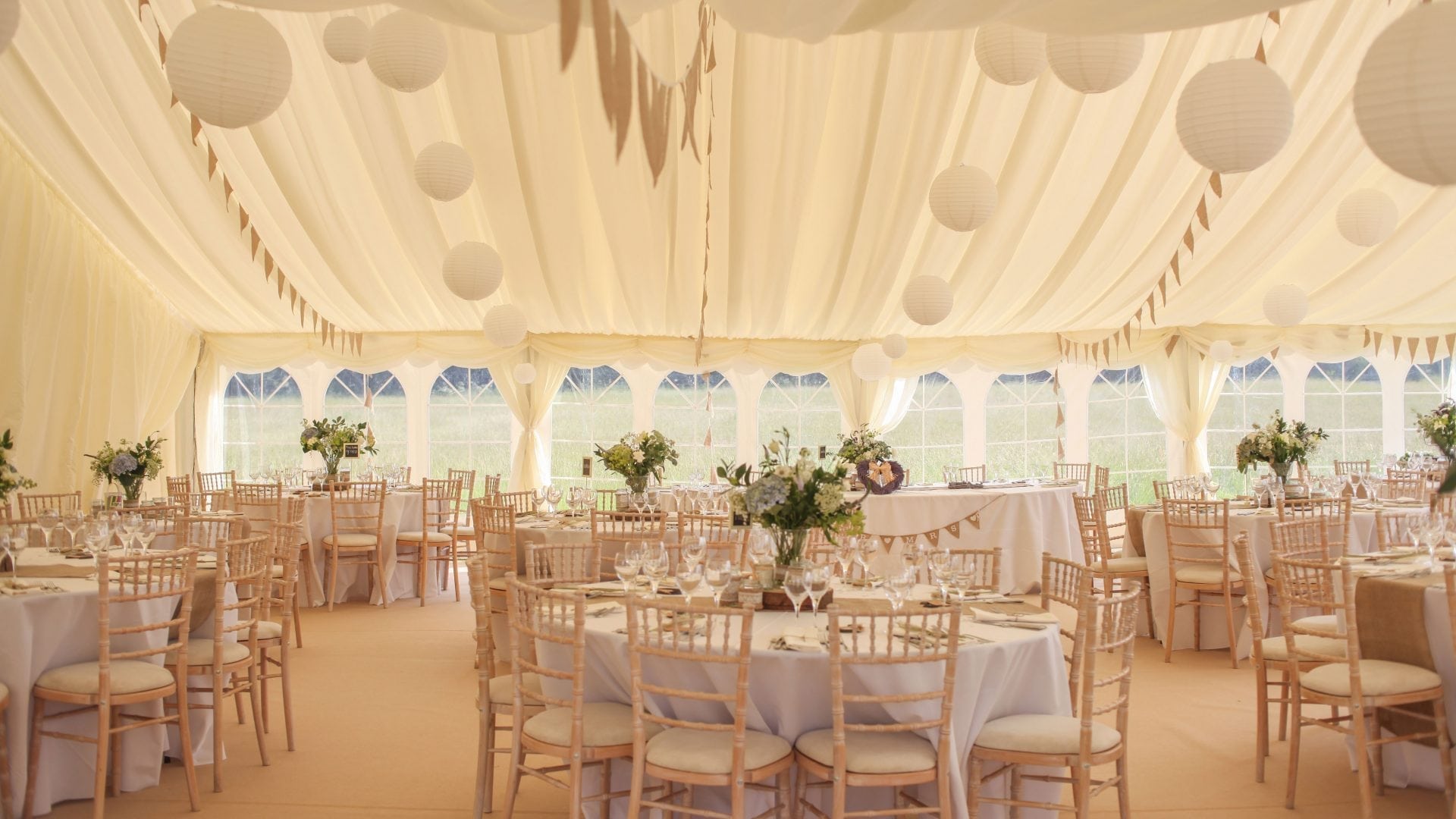
# How to Plan a Marquee Wedding
A marquee wedding is, at its core, a question of construction. You are building a venue from scratch in a field, a garden, or on an estate — and everything else flows from that. The caterer needs to know where the kitchen will be. The band needs to know the power supply. The florist needs the ceiling height. The photographer needs to know which direction the light falls at 7pm.
None of this is complicated. But it is sequential, and the sequence matters. This guide takes you through the full planning timeline, from the moment you decide on a marquee to the evening of the wedding.
Twelve months out
Book the marquee and hold the date.
Peak summer dates — late June, July, and August — are booked a year or more in advance by the marquee companies that do this well. If you have a date in mind, securing the marquee first is the right move. Everything else can follow.
What you need at this stage: a date, a location, and a rough guest count. You do not need to have chosen the caterer, the florist, or the colour of the lining. A site visit and an initial quote are enough to hold the date.
Visit the site with your marquee company.
This is the most important practical step in the entire process, and it should happen early. The site visit establishes what is possible: which structures will fit, where the power will come from, how caterers and suppliers will access the site, and whether the ground is likely to need any preparation. It is also where your marquee company will give you honest information about what your specific site can and cannot accommodate.
Set the guest list to within 10%.
You do not need a final RSVP count at this stage. But you do need to know whether you are planning for 80 guests or 180. The structure size, and therefore the base cost of the event, depends on this number. Getting it broadly right at the twelve-month stage avoids a floor plan being redesigned three months before the wedding.
Six months out
Confirm the floor plan.
With the caterer, the band or DJ, and the rough furniture style agreed, your marquee company can now produce a final scaled floor plan. This shows the dining layout, the dance floor, the bar position, the catering area, and the emergency exit routes. It is the document that every other supplier will work from.
Choose the interior specification.
Flooring type, lining colour, lighting rig, furniture style — these decisions are made at the six-month stage and locked into the quote. Changing them later is possible but introduces cost and complexity. The floor plan helps make these decisions: a dance floor under festoon lighting requires different lining and rigging than a long-table layout with chandeliers.
Confirm your catering arrangement.
Your caterer needs to know: the power supply available (voltage, amperage, number of circuits), the water source, the catering run dimensions, and the access route for the catering vehicle. Your marquee company will provide the structural information. The caterer tells you the kitchen equipment specification. The two need to align.
Book the key suppliers.
Florist, photographer, videographer, entertainment. At six months out, the best people in each category are already booked for peak summer dates. If you have someone in mind, confirm them now.
Three months out
Finalise the guest list and confirm the table plan.
Final RSVPs allow your marquee company to confirm the floor plan and your caterer to confirm the service approach. If the guest count has moved significantly from the original estimate, flag it now — there is time to adjust the structure or the layout.
Confirm the logistics plan.
Who is arriving on site and when? The caterer's vehicles, the florist's van, the band's equipment. Your marquee company will produce a build and access schedule; the other suppliers need to know their window. For events with multiple suppliers, this coordination is worth doing in writing.
Walk the site with the venue or landowner.
If you are using a private property or a farm, a walkthrough with the owner at three months confirms that nothing has changed — no new fencing, no planned groundworks, no conflict with another event on the same date.
Confirm the power plan.
Generator or mains? If generator, has it been sized to the load? The load includes the catering equipment, the lighting, the band's PA, and the heating or cooling. Your marquee company will coordinate this, but the caterer and the band both need to provide their power requirements in time for the specification to be confirmed.
One month out
Confirm the timeline with all suppliers.
A single document: who arrives when, in what order, and how long they have. The marquee build and breakdown bookend everything else. All supplier windows fit within them. Share it with everyone and ask for confirmation that it works.
Final headcount to caterer and marquee company.
The number that changes the floor plan, the linen order, and the catering numbers. Give it as accurately as you can.
Brief the person managing the day.
If you are using a wedding coordinator, this is when the full handover happens. If you are relying on family or a trusted friend, a clear briefing — who to call for which issue — is worth doing properly.
The week of the wedding
The marquee arrives.
The build typically takes one to two days for a standard wedding marquee. You do not need to be present for this, but it is worth a visit once the structure is up and the interior is taking shape. If anything needs adjusting — a table moved, a lining swapped — this is when to do it.
Supplier deliveries and setup.
Florist, furniture, AV — typically arriving in the day or two before the wedding. The access schedule manages who comes when. Your marquee company will have someone available to coordinate access and answer practical questions from other suppliers.
A final walkthrough.
The evening before the wedding, or the morning of. Walk the space with the person managing the day. Check the lighting works. Check the heating or cooling. Check the emergency exits are clear. Fix anything that needs fixing while there is still time.
The day itself
From this point, the logistics are handled. The structure is up, the interior is dressed, the suppliers know their jobs.
Your role is to be present for the event, not to manage it. If something needs attention — a technical issue, a supplier question — that is for the person managing the day and, ultimately, your marquee company's on-site team.
A well-planned marquee wedding runs itself. The planning you have done in the months before is why.
Frequently asked questions
How long does it take to put up a wedding marquee?
For a standard wedding-scale structure, the build typically takes one to two days. Larger structures, complex interiors, or difficult access can extend this. The breakdown is usually faster — a single day for most sizes. Your marquee company will confirm the build and breakdown schedule as part of the logistics plan.
What happens if it rains on my wedding day?
A properly erected and weatherproof marquee is not affected by rain. The structure handles it, the interior stays dry, and the event continues as planned. The practical considerations are the ground outside — entrance matting, temporary paths — and the arrival of guests. Your marquee company will advise on these at the planning stage if the site warrants it.
Do I need a generator, or can I use mains power?
It depends on the site and the event specification. Mains power, where available and adequate, is the simpler option. Where mains is not available or not sufficient for the load, a generator is specified and sized accordingly. Your marquee company will assess the power requirement at the site visit and recommend the appropriate solution.